A Guide to Advertising in Dubai
To make a real impact with your advertising in Dubai, you need a smart mix of digital savvy and bold traditional media. Getting it right comes down to understanding what makes this market tick—from its incredibly diverse, high-income population to its role as a major global business hub. The real secret is creating culturally sharp campaigns that cut through the noise in a fiercely competitive city.
Getting to Grips with Dubai's Unique Advertising Scene
Before you can succeed in advertising in Dubai, you need to appreciate why this city is such a magnet for brands. It's not just about the iconic skyline and luxury shopping centres; it's a strategic crossroads where global ambition and rich cultural traditions meet. This unique environment is a goldmine for businesses that take the time to learn its intricacies.
From a marketer's perspective, the city's population is a dream come true. You have a melting pot of over 200 nationalities, most with significant spending power. This multiculturalism means a cookie-cutter approach is doomed from the start. Your campaigns have to be nuanced enough to connect with various expatriate communities and the local Emirati population all at once.
What Makes the Market So Appealing?
Dubai's true power lies in its dual identity as a world-class tourist hotspot and a vital business centre. This creates a constant flow of new eyes on your brand, alongside a stable, wealthy residential base. A solid advertising strategy has to speak to both the tourist passing through and the resident who calls Dubai home.
To pull this off, you’ll need a clever fusion of advertising methods. Think about combining a laser-focused social media campaign with a can’t-miss-it billboard along Sheikh Zayed Road. This integrated approach ensures your brand is visible online where people scroll, and offline where big, bold statements are made. As you build out your strategy, it's worth exploring a full suite of options, including general advertising services, to cover all your bases.
At the end of the day, effective advertising in Dubai isn’t just about getting noticed—it's about being relevant. It demands a deep respect for local culture and a real understanding of what drives a truly global audience.
The Digital Gold Rush
The UAE's pivot to digital channels is impossible to ignore. The market is booming, with projections showing a compound annual growth rate (CAGR) of 12.0% between 2025 and 2033. This growth is fired up by massive social media usage and a laser focus from businesses on targeted ads.
One of the biggest trends is programmatic advertising. It's on track to make up about 76% of all digital ad revenues by 2028, which tells you everything you need to know about the market's shift toward data-driven, personalised marketing. You can dig deeper into the UAE's digital advertising market growth and what's behind it.
Winning with Digital Advertising in Dubai
To really connect with an audience in Dubai, you have to go where they are—and that’s online. This isn't just about having a website; it's about building a smart game plan to engage a vibrant, multicultural population across the digital platforms they use every single day. Getting this right means crafting messages that truly land and, ultimately, drive your business forward.
The whole region is shifting gears, and fast. The Middle East and North Africa (MENA) advertising market is projected to grow by 8% in 2025, hitting a massive $6.3 billion. What’s really telling is that digital platforms are expected to gobble up nearly 66% of that pie. This tells us one thing loud and clear: search marketing, social media, and online retail are no longer optional—they're the main event.
This infographic breaks down the key digital channels that are really making waves in Dubai's advertising scene.
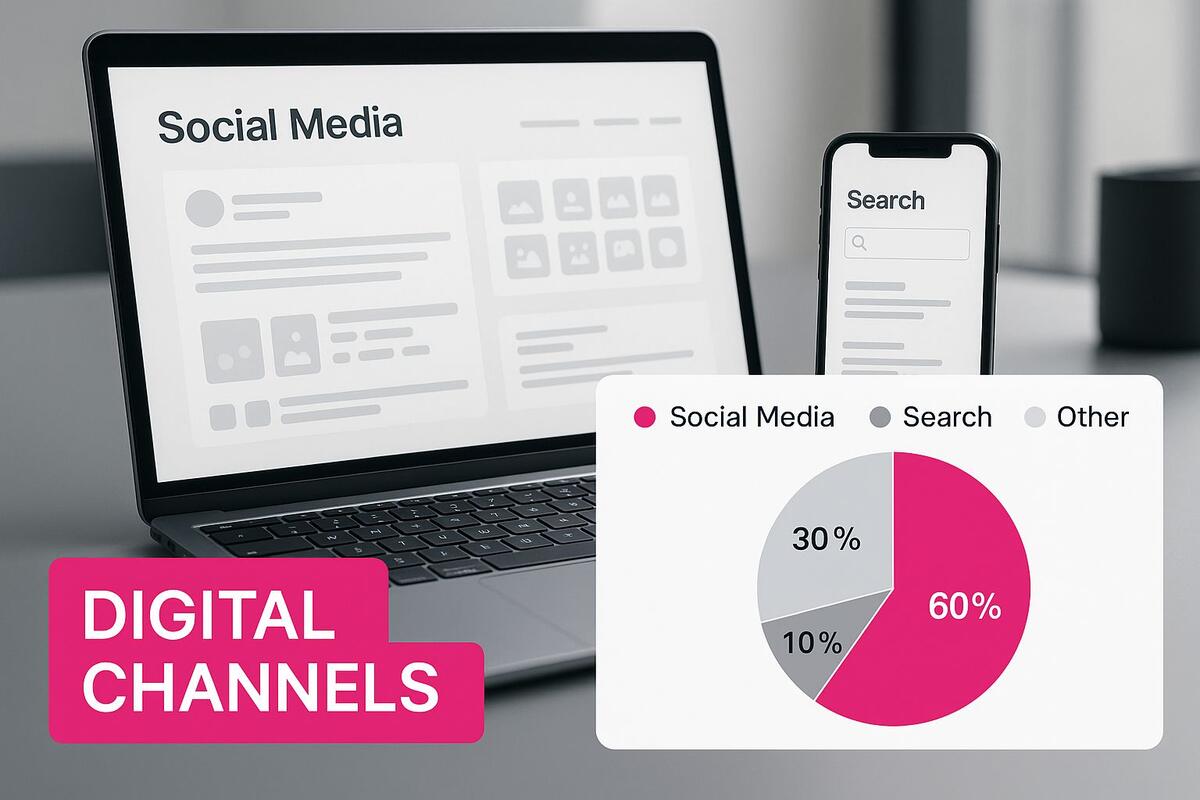
As you can see, it's all about an integrated approach. Your social media efforts need to sync up with your search engine presence and direct marketing to create a seamless experience for your audience.
Mastering Social Media Platforms
In Dubai, social media is more than just a way to kill time; it’s woven into the fabric of daily life and commerce. If you want to reach specific groups, you have to be fluent in the language of platforms like Instagram, TikTok, and LinkedIn.
Instagram is still the undisputed champion for anything visual—think lifestyle, fashion, and luxury goods. Meanwhile, TikTok has completely captivated the younger crowd with its energetic, creative, and often hilarious short-form videos. And for any B2B play, LinkedIn is the go-to digital boardroom for networking and generating serious leads.
The real secret is matching your message to the medium. That sleek, professional video that gets tons of engagement on LinkedIn will almost certainly fall flat on TikTok, where people crave authenticity and a bit of fun.
Your strategy has to be flexible. Pushing the same content everywhere just doesn't work. To build a real connection, your posts need to feel like they belong on each specific platform, not like a generic ad dropped in from another world.
To help you navigate these options, here's a quick comparison of the most popular platforms in the city.
Key Digital Advertising Channels in Dubai
Channel
Primary Audience
Key Strengths
Best For
Millennials, Gen Z, lifestyle enthusiasts
Highly visual, strong influencer network, powerful for e-commerce
Fashion, beauty, food & beverage, luxury goods, travel
TikTok
Gen Z, younger millennials
High engagement rates, viral potential, trend-driven content
Entertainment, fashion, FMCG, brands targeting youth
Professionals, B2B decision-makers, expats
Professional networking, lead generation, industry authority
B2B services, corporate branding, recruitment, finance
Google Search
Broad audience with active intent
Captures users actively looking for products/services, high conversion
All businesses, especially local services and e-commerce
Snapchat
Younger demographic (under 30)
High engagement, augmented reality (AR) filters, ephemeral content
Events, retail promotions, brands with a youthful voice
Broad demographic, older millennials, families
Extensive user base, detailed targeting options, community building
Local businesses, events, real estate, community-focused brands
Choosing the right mix of these channels is the first step toward building a campaign that resonates with the right people at the right time.
The Power of Search Engine Optimisation and PPC
In a city where everyone is searching for something, being visible on Google is non-negotiable. The best approach is a one-two punch: combine Search Engine Optimisation (SEO) for long-term organic visibility with Pay-Per-Click (PPC) ads for immediate impact. If you're just starting out, a solid beginners guide to digital marketing can help you get your bearings.
The keyword game in Dubai is especially tricky because of its multilingual environment. Your research can't just stick to English; you need to dig into Arabic terms, local dialects, and even common slang to truly cover all your bases.
For effective search advertising in Dubai, focus on these essentials:
- Local SEO: Make sure your Google Business Profile is perfectly optimised. For any brick-and-mortar business, showing up in local map searches is absolutely crucial.
- Bilingual Content: Creating great content in both English and Arabic doesn’t just double your keywords; it massively expands your potential audience.
- Targeted PPC Campaigns: Google Ads lets you get incredibly specific. Use its targeting to zero in on the exact demographics, interests, and even specific neighbourhoods you want to reach.
If you’re looking to get serious about paid search, our in-depth guide to PPC advertising in Dubai is packed with actionable strategies to help you get the best possible return on your ad spend.
Influencer Marketing and Programmatic Advertising
Influencer marketing has incredible traction in Dubai. Partnering with local creators who have a genuine rapport with their followers can build a level of trust that traditional advertising just can't buy.
These collaborations can be big or small. You might work with micro-influencers who have a dedicated niche following or go all-in with major celebrities to create a huge splash. The right choice comes down to your campaign goals and, of course, your budget. For a deeper look at what to expect, see our guide to choosing an influencer marketing agency in Dubai.
At the same time, programmatic advertising is quickly becoming a major player. This technology uses AI to automatically buy ad space in real-time, making your campaigns incredibly efficient. It sifts through user data to show your ads to the most relevant people at just the right moment, which means less wasted spend and better results for you.
Making an Impact with Traditional and OOH Advertising
While a strong digital presence is crucial, you can't really crack the Dubai market without tapping into the sheer power of traditional media. In a city famous for its larger-than-life architecture, Out-of-Home (OOH) advertising makes a statement that’s impossible to ignore. It builds a kind of tangible credibility that just scrolling on a screen can't always match.
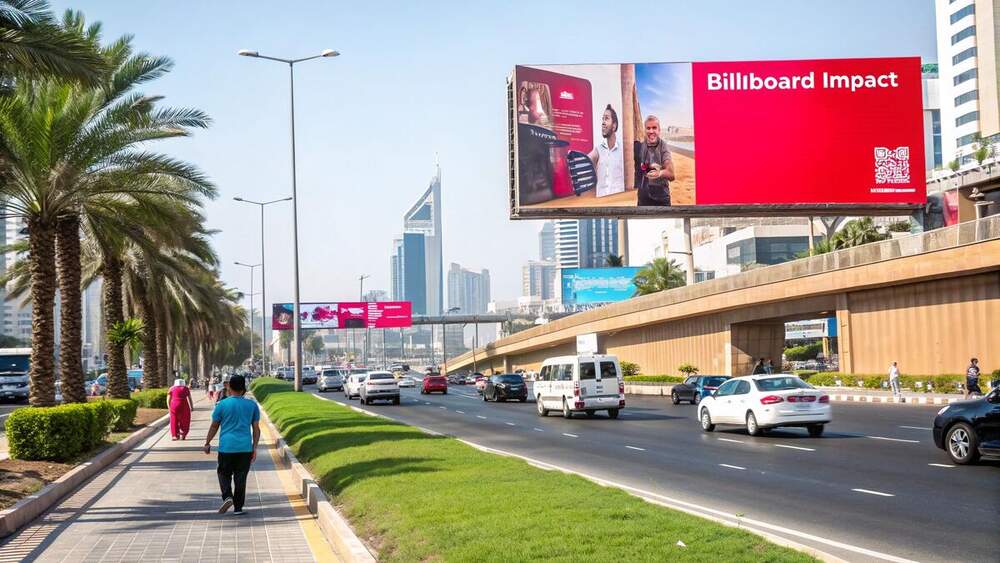
Think of it this way: a targeted social media ad is like a personal conversation, but a massive billboard is a public declaration. Both are essential, but the public one commands a different kind of authority. In Dubai, OOH isn’t just advertising; it transforms the city’s stunning infrastructure into a canvas for brands.
The Unmissable Power of Billboards
Nowhere is this more obvious than along Sheikh Zayed Road. The giant digital and static billboards lining this 12-lane artery aren't just ads; they're landmarks. Getting your brand up there is a clear signal that you’ve arrived. It screams prestige and confidence, reaching a captive audience of millions of commuters, residents, and tourists every week.
But the strategy isn't just about being seen—it's about being seen in the right place. A luxury car brand might snag a spot near the Dubai Mall exit, whilst a new fintech app might target the stretch around Dubai Internet City. The high cost is often justified by the massive volume and quality of impressions.
A well-placed billboard on Sheikh Zayed Road creates a ripple effect. These campaigns don't just stay on the road; they get people talking, get shared on social media, and amplify their own reach, blurring the lines between the physical and digital worlds.
Outdoor advertising is a solid bet here and it's only getting bigger. The UAE's billboard and outdoor advertising market is projected to grow at a CAGR of 6.4% between 2025 and 2030, showing it has real staying power. You can dive deeper into the market's future on Grand View Research.
Capitalising on Transit Advertising
Once you look beyond the motorways, you'll find another incredibly effective channel: transit advertising. Millions of people use Dubai's top-tier public transport system every day. Advertising on the Metro, buses, and taxis puts your brand right in front of a huge, diverse cross-section of the city's population.
In fact, transit advertising holds the largest share of the OOH market, bringing in about 23.08% of the revenue in 2024. This isn't surprising, given Dubai's constant motion and extensive transport network.
Here are the key players:
- Dubai Metro: Full train wraps and interior panels grab the attention of daily commuters, giving you prolonged exposure whilst they travel. It's a perfect spot for everything from new banking services to mobile game launches.
- Taxis and Ride-Sharing: Branded cars and in-vehicle screens cruise all over the city, hitting different neighbourhoods and demographics. This mobile approach ensures your message is seen everywhere from business hubs to residential communities.
- Bus Advertising: Think of a full bus wrap as a moving billboard. It gives you widespread coverage that a single, static billboard on one road just can't compete with.
Each of these options has its own strategic advantage, letting you fine-tune your campaign to hit specific locations or commuter profiles.
Print and Radio Still Hold Their Ground
Even with the digital boom, some old-school channels are thriving by speaking to specific, high-value audiences. Don't write off print, especially in luxury lifestyle and business magazines. A glossy, full-page ad in a premium publication carries a sense of exclusivity and quality that some brands need.
Radio is far from dead, too. A huge chunk of the population commutes by car, making radio campaigns on popular English and Arabic stations a direct line to a captive audience. Those morning and evening drive-time slots are prime real estate for reaching professionals.
At the end of the day, a truly knockout strategy for advertising in Dubai doesn’t pit digital against traditional—it weaves them together. Imagine a commuter who sees your billboard on Sheikh Zayed Road, hears your ad on the radio during their drive, and then gets a slick, targeted social media post later that evening. That's how you build familiarity, drive your message home, and cement your brand as a major player in the market.
Navigating Cultural Norms and Advertising Laws
Creating a campaign that gets results is one thing. Creating one that does so respectfully and legally is the key to lasting success in Dubai. This is precisely where many international brands get tripped up, underestimating the fine balance between creative punch and cultural sensitivity. Getting this wrong can mean rejected ads, a torched budget, and a real dent in your brand’s reputation.
Think of it as learning the local dialect of marketing. While the language of business might seem universal, the nuances here are intensely local. A message that lands perfectly in London or New York might come across as tone-deaf or even inappropriate in the UAE. Success demands a genuine effort to understand and respect the values that shape society here.
This isn't about boxing yourself in with restrictive rules that kill creativity. It's about being smart and thoughtful, crafting advertising that builds a real connection with an incredibly diverse audience. By understanding the cultural landscape, you can create campaigns that are not only compliant but far more effective because they resonate on a much deeper level.
Understanding Key Cultural Considerations
Respect is the foundation of all communication in Dubai. This principle flows directly into advertising, where modesty, family values, and religious observances are held in high regard. Overlooking these elements is a fast track to alienating the very customers you’re trying to reach.
Take the holy month of Ramadan, for example. The entire rhythm of the city changes. Advertising content should mirror this shift, leaning into themes of community, generosity, and reflection. A loud, sales-heavy message during fasting hours just feels wrong and can be seen as deeply insensitive.
Visuals need the same careful thought. Imagery should always be modest and respectful, steering clear of anything that could be considered offensive or overly revealing. This applies to how people are dressed and the way they interact.
To create campaigns that truly connect, keep these points front and centre:
- Respect for Religion and Tradition: Never treat religious symbols or concepts casually. All advertising must align with Islamic values and local traditions.
- Modesty in Portrayals: Make sure any models in your ads—both men and women—are dressed modestly. This is a critical checkpoint for getting your campaign approved.
- Family-Centric Messaging: The family unit is the heart of the culture. Campaigns that celebrate family togetherness, respect for elders, and community spirit almost always perform well.
- Multicultural Awareness: While Emirati culture is the bedrock, remember you’re also talking to a massive expatriate population from every corner of the globe. Your messaging needs to be inclusive. Building a strong brand identity is key to connecting with these diverse audiences, and our guide on branding in Abu Dhabi offers valuable insights that apply across the UAE.
Demystifying the Legal Framework
Beyond the cultural side, advertising in Dubai operates under a clear legal framework designed to protect consumers and keep the playing field fair. The main regulatory body you'll be dealing with is the National Media Council (NMC), which sets the standards for all advertising content in the UAE.
Getting your ads approved by the right authorities is a non-negotiable step for most campaigns, especially for big out-of-home billboards or print placements. The process is there to ensure everything is truthful, ethical, and in line with the country's social values.
The guiding principle of UAE advertising law is straightforward: be truthful and be respectful. Misleading claims, fake promotions, and content that offends public morality are strictly forbidden and can lead to serious penalties.
Following these rules isn't just about dodging fines; it’s about building trust. Consumers here are savvy and they value honesty from brands. A transparent, compliant campaign shows your company is committed to doing business the right way, and that in itself is a powerful brand builder. Make sure your pre-launch checklist always includes verifying every claim is backed up and every image is respectful.
How to Budget and Measure Your Campaign Success
A killer creative idea is just the starting point. Without a smart financial plan and a clear way to measure what’s working, even the most brilliant campaigns can fizzle out. Let's get down to the brass tacks: the numbers. This is where we translate your big-picture goals for advertising in Dubai into a real-world budget and a system for tracking your return.

Setting a budget in Dubai means getting a feel for the local market, where costs can swing wildly from one channel to another. A highly targeted social media push and a massive billboard on Sheikh Zayed Road exist in two completely different financial universes. The trick is to put your money where it will have the greatest impact on your specific goals.
Setting a Realistic Advertising Budget
Your budget should be a direct reflection of what you're trying to achieve. Are you aiming to build massive brand awareness, or are you laser-focused on driving immediate online sales? Your answer will determine how you allocate your funds.
For instance, a campaign designed for brand recognition might pour money into high-visibility channels like outdoor advertising and video. On the other hand, a campaign built for sales will funnel resources into performance-driven platforms like Google Ads and hyper-targeted social media promotions.
To give you a clearer idea of what to expect, here’s a look at some typical monthly budget ranges for advertising in Dubai. Think of this as a starting point to help you anchor your financial planning.
Estimated Advertising Costs in Dubai
Advertising Channel
Low-End Monthly Budget (AED)
High-End Monthly Budget (AED)
Primary Objective
Social Media Ads
10,000
50,000+
Lead Generation, Brand Awareness
Google PPC Ads
15,000
75,000+
Direct Sales, Lead Capture
Influencer Marketing
5,000
100,000+
Trust Building, Brand Endorsement
OOH (Billboard)
150,000
600,000+
Mass Awareness, Brand Prestige
Print (Magazine Ad)
20,000
80,000+
Niche Targeting, Luxury Branding
Radio Advertising
25,000
100,000+
Commuter Reach, Local Promotions
Of course, these are just estimates. Factors like seasonality, the quality of your ad placement, and how long your campaign runs will all influence the final cost. The key takeaway is to start with a clear objective and build your budget from there, not the other way around.
Tracking What Truly Matters
Once your campaign is out in the wild, the game shifts from spending money to measuring its effect. It's incredibly easy to get distracted by "vanity metrics"—things like likes, shares, and impressions. While they might feel good, they don't always tell you if your investment is actually moving the needle for your business.
The most successful advertisers in Dubai are obsessed with data that connects directly to business outcomes. They focus relentlessly on metrics that prove the real-world value of their marketing spend, allowing them to justify budgets and make smarter decisions for future campaigns.
To do this right, you need to zero in on the Key Performance Indicators (KPIs) that measure real business impact. These are the numbers that tell you if you're actually making money.
Here are the essential KPIs you should be watching like a hawk:
- Return on Ad Spend (ROAS): This is the ultimate test of profitability. It answers the simple question: for every dirham we spent, how many did we make back? A 4:1 ROAS, for example, means you generated AED 4 in revenue for every AED 1 spent.
- Cost Per Acquisition (CPA): This tells you exactly how much it costs, on average, to win a new customer. It’s a crucial metric for understanding how efficient your campaigns are at turning prospects into buyers.
- Customer Lifetime Value (CLV): This KPI looks at the big picture, projecting the total revenue you can expect from a single customer over their entire relationship with your brand. When you compare CLV to CPA, you quickly see if your customer acquisition costs are sustainable for the long haul.
- Conversion Rate: This is simply the percentage of people who take the action you want them to, whether that’s making a purchase or signing up for a newsletter. It's a direct measure of how compelling your ads and landing pages are.
Keeping a close eye on these figures lets you see what’s working and what’s not, so you can double down on your most effective channels. For a deeper look at this, check out our guide on effective marketing campaign tracking. It’s packed with the tools and techniques you need to make data-driven decisions and prove the value of your advertising.
Ready to create an advertising strategy that truly connects with the Dubai market? At Grassroots Creative Agency, we manage Google Ads and Meta Ads for businesses across the UAE — 200+ brands, 7 years in Dubai, no contracts. See our ad management packages from 3,000 AED/month and let us build campaigns that deliver real, measurable results.
Frequently Asked Questions
What are the best advertising channels for a small business in Dubai?
If you're working with a tighter budget, focus on digital first: a mix of targeted social media ads (Instagram and Facebook let you zero in on specific demographics and interests) and Google Ads PPC, which captures people at the moment they're actively searching. Local SEO is also essential for any business with a physical storefront, since it costs more in time than money but drives customers right in your neighbourhood. Content marketing rounds this out as a longer term play, building trust and organic traffic over time.
Do I need to advertise in both Arabic and English?
Yes. Dubai's population is a genuine melting pot of Emiratis, Arab expats and a large global community, so a single language approach leaves a huge chunk of potential customers out of the conversation. English reaches the diverse expatriate community and tourists, while Arabic content builds authentic, deeper trust with Emiratis and the wider Arab population. It's worth thinking in terms of transcreation rather than direct translation: adapting tone, idioms and cultural references so the message lands properly in each language.
How much should I budget for advertising in Dubai?
Costs vary widely by channel, so your budget should follow your objective rather than a fixed rule of thumb. As a rough guide, social media ads typically run from around AED 10,000 to 50,000+ a month, Google PPC from AED 15,000 to 75,000+, and OOH billboard placements (such as Sheikh Zayed Road) can range from AED 150,000 up to 600,000+ for mass awareness campaigns. Seasonality, placement quality and campaign length will all move these numbers, so treat them as a starting point for planning rather than a fixed price.
Who enforces advertising rules in Dubai, and what happens if I break them?
The National Media Council (NMC) sets the main standards for advertising content in the UAE, with the Department of Economic Development (DED) and Dubai Municipality also involved, particularly for outdoor ads. High-profile campaigns such as large OOH billboards, major print ads or TV commercials generally need pre-approval before they run, and regulators actively monitor the market alongside reports from competitors and the public. Violations can range from an order to pull the campaign to significant financial penalties, and repeat or serious breaches can even put a business's trade licence at risk.